Lighting Is Not a Line Item. It Is the Design.
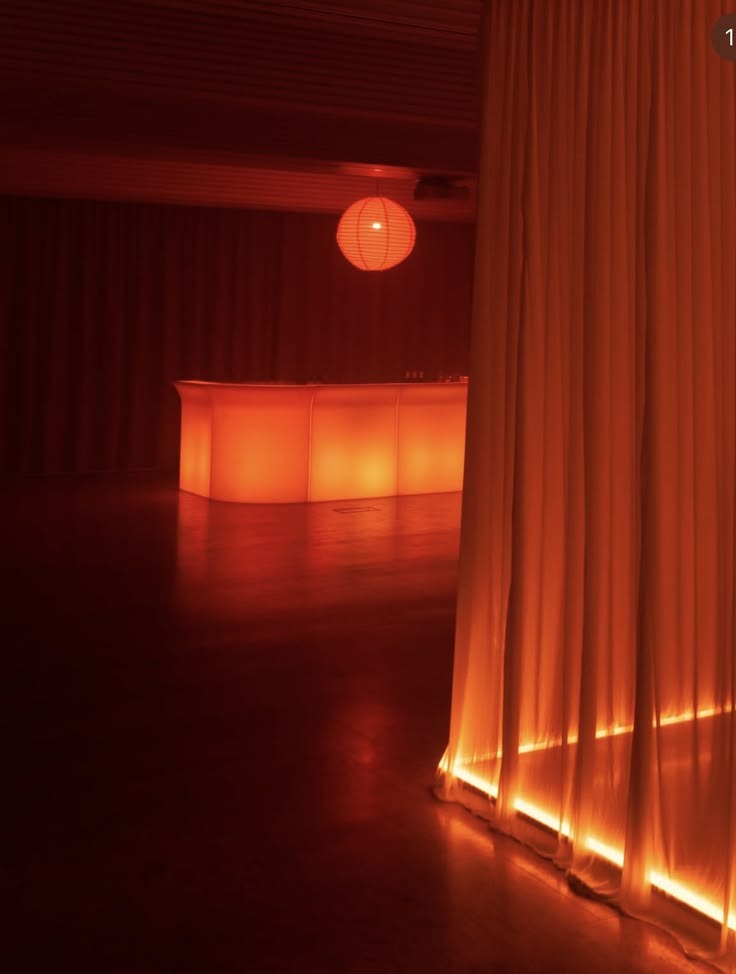
Lighting touches every other design decision you'll make. It changes how your colors read, how your photos turn out, how a room feels at 6pm versus 10pm. And it's usually the first thing couples try to cut.
Color temperature is the piece most people never think about. Candlelight sits around 1800–2200K — warm, amber, flattering. A standard bulb runs closer to 2700K. Fluorescent and most venue-house lighting climbs to 4000K or higher — cold, flat, and unforgiving in photographs. Mix those temperatures in one room and everything looks slightly wrong, even if no one can say exactly why.
"If a couple wants to cut the lighting budget, I cut florals first. Every time. Without exception."
That's not a preference, it's a hierarchy. Florals fade into the background of a photo if the light is wrong. Get the light right, and even modest florals look intentional. Get it wrong, and no amount of flowers fixes it.
A few rules I don't bend on:
Pin spots. Every centerpiece, cake, and focal arrangement needs its own direct light, or it disappears into the room the moment the sun goes down.
Candles in abundance. Real flame, not battery pillars. Candlelight is the single cheapest way to buy warmth, and there's no substitute for the way it moves.
Dimmers on everything. A room should shift with the night — bright for cocktail hour, low for dinner, lower still once dancing starts. Static lighting keeps a room stuck in one mood all night.
Uplighting — warm or not at all. Cool-toned uplighting is the fastest way to make a room feel like a conference hall. If you can't get warm-temperature fixtures, skip uplighting entirely.
Think about a wedding in phases: cocktail hour wants bright, energetic light that photographs well and keeps people moving. Dinner wants it lower and warmer, candlelight-driven, conversation-scaled. Dancing wants movement — texture, contrast, something with energy. The after-party, if there is one, can go moodier and lower still. A room that doesn't shift through these phases starts to feel like one long moment instead of a night.
"Light dictates color. Finalize your lighting direction before locking any palette in final form."
This is the order most couples get backwards. They pick linens and florals first, then ask the lighting designer to make it work. Flip it. Decide what the room will feel like after dark, and let the palette follow from there.
Escape the mundane.